
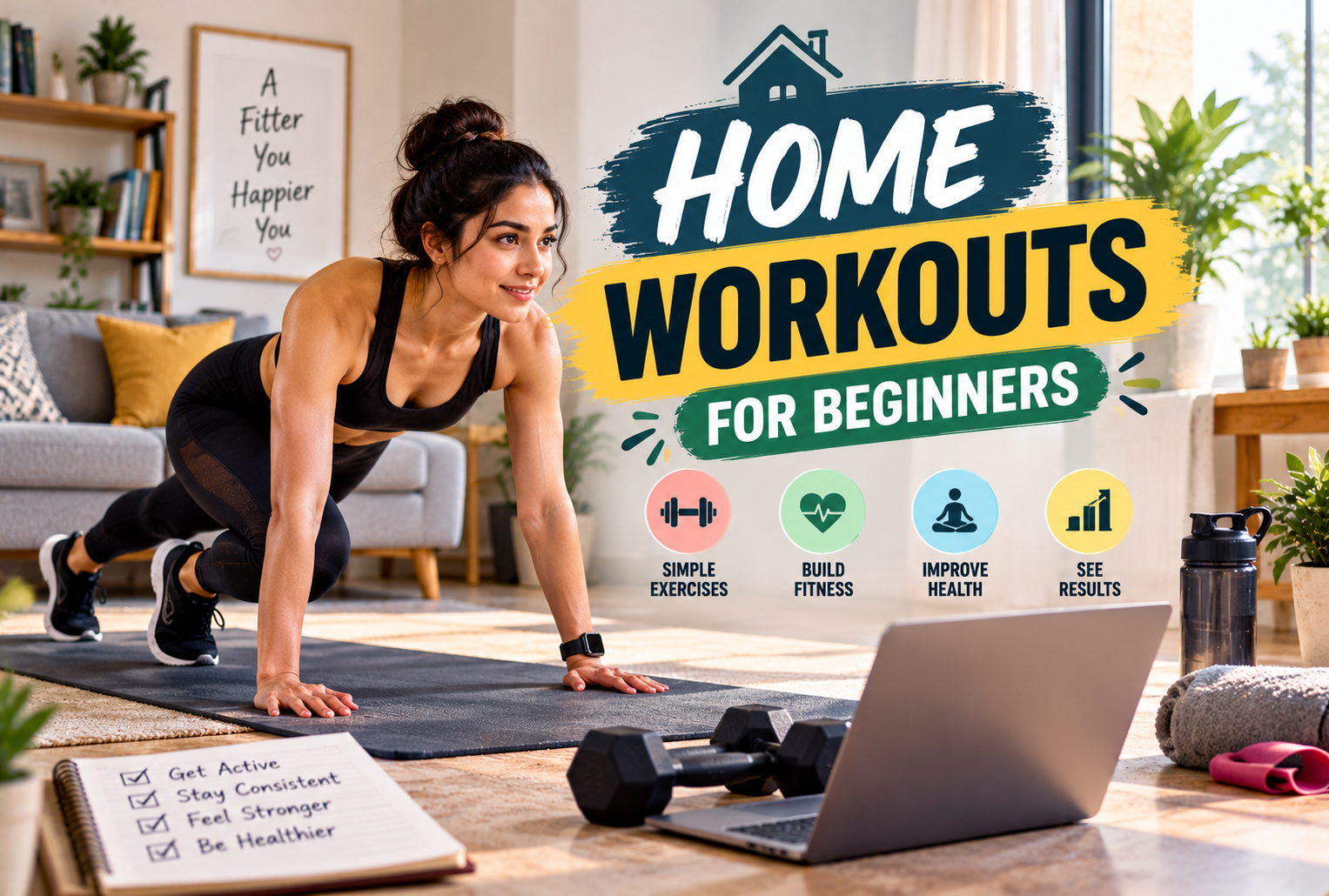
Starting a fitness journey does not require an expensive gym membership, advanced equipment, or hours of exercise every day. With the right approach, you can improve your strength, flexibility, balance, and overall fitness from the comfort of your home.
For people with busy schedules, home workouts for beginners offer a practical way to become more active without traveling to a gym. Whether you are a student, working professional, or someone returning to exercise after a long break, simple movements can help you build a consistent routine.
The key is to start slowly, focus on proper exercise technique, and increase your activity gradually.
This guide explains beginner-friendly exercises, weekly workout schedules, bodyweight movements, and useful fitness tips to help you develop healthy habits.
Home Workouts for Beginners: Why Start Exercising at Home?
A beginner fitness routine at home allows you to exercise at your own pace without worrying about complicated machines or crowded fitness centers.
One major advantage is convenience. You can exercise in your living room, bedroom, or any safe space with enough room to move comfortably.
Another benefit is affordability. Many effective exercises use your own body weight, eliminating the need for expensive fitness equipment.
Regular physical activity can support heart health, muscular strength, mobility, mood, and overall well-being.
According to the World Health Organization, adults should generally aim for 150–300 minutes of moderate-intensity aerobic activity per week, along with muscle-strengthening activities on at least two days.
Beginners do not need to reach these targets immediately. Even short sessions can help establish a sustainable fitness habit.
7 Easy Exercises for Beginners Without Equipment
The following bodyweight exercises for beginners can be performed at home with minimal space.
1. Marching in Place
Marching in place is a simple warm-up exercise that gently increases your heart rate.
Stand upright, lift one knee at a time, and swing your arms naturally.
Suggested duration: 2–3 minutes.
Benefits: Supports circulation, coordination, and cardiovascular activity.
2. Bodyweight Squats
Squats strengthen the thighs, hips, and glutes.
Stand with your feet approximately shoulder-width apart, bend your knees and hips as though sitting on a chair, and return to standing.
Suggested repetitions: 8–12.
Beginner modification: Use a sturdy chair for support or practice controlled sit-to-stand movements.
3. Wall Push-Ups
Wall push-ups are an accessible alternative to traditional floor push-ups.
Place your hands against a wall, bend your elbows to bring your chest closer, and gently push back.
Suggested repetitions: 8–12.
Benefits: Strengthens the chest, shoulders, and arms.
4. Glute Bridges
Lie on your back with your knees bent and feet flat on the floor.
Lift your hips slowly, pause briefly, and lower them with control.
Suggested repetitions: 10–12.
Benefits: Activates the glutes and hip muscles.
5. Standing Knee Raises
Stand upright and lift your knees alternately toward your waist at a comfortable pace.
Suggested duration: 30–45 seconds.
Benefits: Supports balance, coordination, and gentle cardiovascular activity.
6. Bird-Dog Exercise
Begin on your hands and knees. Extend one arm and the opposite leg while keeping your back stable.
Return to the starting position and switch sides.
Suggested repetitions: 6–8 per side.
Benefits: Helps develop core stability and coordination.
7. Standing Calf Raises
Stand near a wall or sturdy chair for support.
Raise your heels slowly, balance briefly, and lower them.
Suggested repetitions: 10–15.
Benefits: Strengthens the calf muscles and supports ankle stability.
Full Body Workout at Home: 20-Minute Beginner Routine
A full body workout at home should include movements that engage different muscle groups without causing excessive fatigue.
This 20-minute home workout provides a simple starting structure.
| Exercise | Duration |
|---|---|
| Warm-up: Marching in Place | 3 minutes |
| Bodyweight Squats | 2 minutes |
| Wall Push-Ups | 2 minutes |
| Glute Bridges | 2 minutes |
| Standing Knee Raises | 2 minutes |
| Bird-Dog Exercise | 2 minutes |
| Calf Raises | 2 minutes |
| Gentle Stretching and Cool-Down | 5 minutes |
| Total | 20 minutes |
Perform repetitions at a comfortable pace and use the allotted time for rest breaks when needed.
Avoid rushing through exercises simply to complete more repetitions.
Beginner Workout Plan: A Simple 7-Day Schedule
A practical beginner workout plan should balance exercise, recovery, and consistency.
| Day | Activity | Suggested Duration |
|---|---|---|
| Monday | Full-body beginner workout | 20 minutes |
| Tuesday | Comfortable walking | 15–20 minutes |
| Wednesday | Light stretching and mobility | 15 minutes |
| Thursday | Full-body beginner workout | 20 minutes |
| Friday | Walking or low-impact cardio | 20 minutes |
| Saturday | Gentle yoga or mobility | 15–20 minutes |
| Sunday | Rest or optional easy walking | As comfortable |
This schedule allows beginners to become more active without performing intense workouts every day.
As your fitness improves, gradually increase exercise duration, repetitions, or weekly activity.
Daily Exercise Routine at Home: Building Consistency
Creating a daily exercise routine at home is often more valuable than attempting occasional intense workouts.
Choose a time that fits naturally into your schedule.
Some people prefer morning workouts because they help establish a predictable routine. Others find evening sessions more convenient after work.
Start with manageable goals, such as 10–20 minutes of movement, and increase gradually.
Keep a simple fitness tracker or exercise journal to record your progress.
Remember that daily movement does not mean performing challenging strength exercises every day. Recovery days are an important part of a balanced fitness routine.
Workout Without Equipment: Common Mistakes to Avoid
A workout without equipment can be effective, but beginners should avoid several common mistakes.
Skipping warm-ups: Beginning intense movements without preparation may increase discomfort or injury risk.
Using incorrect technique: Poor movement control can place unnecessary stress on muscles and joints.
Doing too much too soon: Excessive exercise can cause fatigue and discourage consistency.
Ignoring recovery: Muscles need sufficient rest between challenging strength-training sessions.
Comparing progress: Fitness improvements vary depending on age, health, activity history, and individual circumstances.
Focus on controlled movement, gradual progression, and realistic expectations.
Home Fitness Tips for Better Results
These practical home fitness tips can help make your exercise routine more sustainable.
-
Set realistic goals: Begin with achievable weekly activity targets.
-
Stay hydrated: Drink fluids according to your activity level and environmental conditions.
-
Choose comfortable clothing: Wear clothes that allow unrestricted movement.
-
Prioritize proper technique: Quality matters more than exercise speed.
-
Maintain a balanced diet: Include suitable sources of protein, carbohydrates, healthy fats, fruits, and vegetables.
-
Get adequate sleep: Recovery supports your overall fitness progress.
-
Track improvements: Notice changes in strength, endurance, mobility, and confidence.
For additional guidance, explore the CDC Physical Activity Basics.
How to Make Your Home Exercise Plan More Challenging
Once your current home exercise plan becomes comfortable, you can gradually increase the difficulty.
For example, progress from wall push-ups to incline push-ups, or from supported squats to controlled bodyweight squats.
You can also increase repetitions slightly, add another exercise set, or extend walking sessions.
Avoid increasing every exercise variable simultaneously.
A gradual approach gives your body time to adapt and reduces the likelihood of excessive soreness.
When Should Beginners Take Extra Precautions?
Most easy exercises for beginners can be adapted to different fitness levels, but individual health circumstances matter.
People with heart conditions, significant joint problems, recent surgery, pregnancy-related restrictions, or other medical concerns may need personalized exercise advice.
Stop exercising if you experience chest pain, faintness, severe breathlessness, or sudden significant pain. Seek urgent medical attention for serious symptoms.
The NHS exercise guidance offers additional beginner-friendly physical activity information.
Conclusion
Building a healthier lifestyle does not require expensive equipment or complicated workout programs.
The best home workouts for beginners focus on simple exercises, correct technique, gradual progression, and consistency.
By combining a manageable beginner workout plan with regular walking, adequate recovery, and healthy daily habits, you can develop a fitness routine that fits your lifestyle.
Start with what feels achievable, remain patient with your progress, and focus on making physical activity a regular part of your life.
Disclaimer: This article provides general fitness information and is not a substitute for personalized medical or professional exercise advice.