
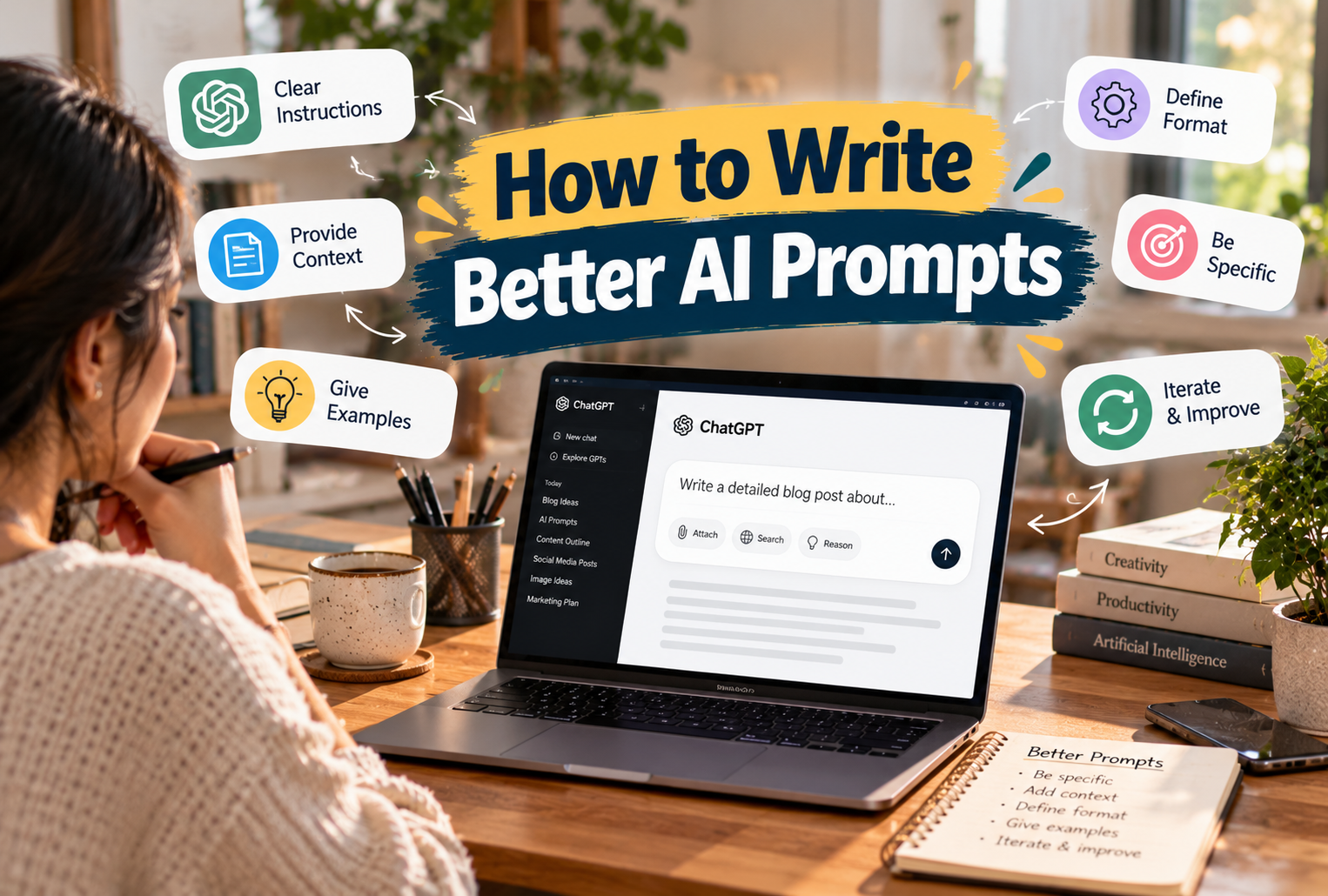
Artificial Intelligence (AI) has become an important part of our daily lives. From writing emails and creating blog posts to solving problems, learning new skills, and generating creative ideas, AI tools are making everyday tasks easier and faster.
However, many beginners face one common problem: AI does not always give the answers they expect.
Sometimes the response is too general, too long, or completely different from what they need. This often happens because the instructions given to the AI tool are not clear enough.
Learning how to write better AI prompts can help you get more accurate, relevant, and useful responses from tools like ChatGPT, Gemini, Claude, and other AI assistants.
The good news is that you do not need technical knowledge or programming skills to write effective prompts. By using simple instructions, adding context, and explaining your expectations, you can significantly improve the quality of AI-generated responses.
In this beginner-friendly guide, we will explore AI prompt writing techniques, practical examples, useful prompt templates, and common mistakes to help you communicate more effectively with AI tools.
What Is an AI Prompt?
An AI prompt is a question, instruction, or message that you give to an artificial intelligence tool to receive a response.
A prompt tells the AI what you want it to do.
For example, you might ask an AI tool to write a blog post, explain a difficult topic, create a social media caption, or help you prepare for an interview.
Simple AI Prompt Example
Basic Prompt:
Write about digital marketing.
This prompt is understandable, but it does not explain what type of content you need.
Better AI Prompt:
Write a 500-word beginner-friendly article about digital marketing. Explain SEO, social media marketing, email marketing, and paid advertising in simple English. Use clear headings and practical examples.
The second prompt gives the AI more information about the topic, length, audience, writing style, and content requirements.
As a result, it is more likely to produce a useful response.
Key Point: A good AI prompt clearly explains what you want, who the response is for, and how the answer should be presented.
Why Is Writing Better AI Prompts Important?
AI tools can help with many different tasks, but the quality of their responses often depends on the instructions they receive.
When your prompt is vague, the AI has to make more assumptions about your expectations.
Clear instructions reduce unnecessary guesswork and help the tool focus on your actual requirements.
Benefits of Writing Effective AI Prompts
-
Better Accuracy: Clear instructions can reduce misunderstandings and irrelevant responses.
-
Saves Time: You may need fewer revisions to get the desired result.
-
Improves Content Quality: Detailed prompts can produce more organised and useful content.
-
Supports Creativity: Specific instructions help AI generate ideas that match your goals.
-
Increases Productivity: You can complete writing, planning, and research-related tasks more efficiently.
-
Better Personalisation: AI can adapt its response to your audience, skill level, and preferred style.
Whether you use AI for education, business, content creation, or daily productivity, learning how to write effective AI prompts can make a noticeable difference.
1. Be Clear About What You Want
The first rule of AI prompt writing for beginners is to use clear and specific instructions.
Avoid asking broad questions when you need a detailed answer.
For example, instead of asking AI to write something about fitness, explain the exact topic and the type of information you want.
Basic Prompt
Give me fitness tips.
Better Prompt
Share 10 simple fitness tips for beginners who work in an office and spend most of the day sitting. Focus on easy habits that do not require gym equipment. Use simple English and short explanations.
Why This Prompt Works Better
The improved prompt clearly mentions:
-
Topic: Fitness tips
-
Audience: Office workers
-
Skill Level: Beginners
-
Requirement: No gym equipment
-
Writing Style: Simple English
-
Format: 10 tips with short explanations
Practical Tip: Before sending a prompt, ask yourself whether someone reading your instructions for the first time would understand exactly what you need.
2. Give AI Enough Background Information
Providing context is one of the easiest ways to improve AI-generated responses.
Context means the background information that helps the AI understand your situation, goals, and requirements.
For example, if you ask AI to create a marketing plan, it needs to know what type of business you run and who your customers are.
Basic Prompt
Create a marketing plan for my business.
Better Prompt
Create a simple digital marketing plan for a small clothing store in India. The store sells affordable women's ethnic wear and wants to attract customers through Instagram and Google Search. Suggest practical marketing activities for the next 30 days with a limited budget.
Why This Prompt Works Better
The AI now understands the business type, target audience, location, marketing platforms, budget limitations, and timeframe.
This helps it suggest more relevant strategies instead of giving a generic marketing plan.
Practical Tip: Include important background details, but avoid adding unnecessary information that does not affect the task.
3. Mention Your Target Audience
One of the most useful tips for writing clear AI instructions is to explain who will read or use the response.
The same topic can be explained differently depending on the audience.
For example, an explanation written for school students will be different from one written for experienced professionals.
Basic Prompt
Explain artificial intelligence.
Better Prompt
Explain artificial intelligence to a 15-year-old student who has no technical background. Use simple English, everyday examples, and short paragraphs. Avoid complicated technical terms.
Why This Prompt Works Better
By identifying the audience, you help the AI choose suitable vocabulary, examples, and explanations.
This technique is useful for blog writing, educational content, business communication, presentations, and social media posts.
Practical Tip: Use phrases such as "for beginners," "for school students," "for small business owners," or "for working professionals" to guide the response.
4. Tell AI Which Writing Style You Prefer
AI tools can write in different styles, including professional, friendly, conversational, educational, and persuasive.
If you do not specify a writing style, the response may not match your expectations.
Basic Prompt
Write an email to a customer.
Better Prompt
Write a polite and professional email to a customer who has asked about a delayed order. Apologise for the inconvenience, explain that the team is checking the delivery status, and assure the customer that an update will be shared soon. Keep the email short and friendly.
Common Writing Styles You Can Request
-
Professional: Suitable for business emails and official communication.
-
Friendly: Useful for customer messages and casual conversations.
-
Conversational: Works well for blogs and social media.
-
Educational: Suitable for tutorials and learning materials.
-
Persuasive: Useful for advertisements and product descriptions.
-
Simple English: Ideal for beginners and general readers.
Practical Tip: If you want natural content, include instructions such as "Use human-friendly language, short sentences, and avoid unnecessary jargon."
5. Specify the Output Format
Sometimes AI gives useful information but presents it in a format that is difficult to use.
For example, you may want a table, but the AI provides long paragraphs.
Mentioning the output format in your prompt helps solve this problem.
Basic Prompt
Compare online and offline shopping.
Better Prompt
Compare online shopping and offline shopping in a simple table. Include price comparison, convenience, product availability, delivery time, and return options. After the table, write a short conclusion explaining which option may be better for different customers.
Useful Output Formats
-
Bullet Points: Best for tips, features, and quick explanations.
-
Tables: Useful for comparisons and organised information.
-
Step-by-Step Guides: Ideal for tutorials and instructions.
-
Short Paragraphs: Helpful for blog posts and articles.
-
Checklists: Useful for planning and completing tasks.
-
Question-and-Answer Format: Suitable for FAQs and interview preparation.
Practical Tip: Tell the AI exactly how you want the information organised instead of spending time rearranging the response later.
6. Set a Clear Word Limit or Response Length
AI responses can sometimes be longer or shorter than expected.
Adding a word limit or preferred response length helps you control the amount of information.
Basic Prompt
Explain SEO.
Better Prompt
Explain SEO in approximately 300 words for beginners. Include what SEO means, why it matters, and the difference between on-page SEO and off-page SEO. Use simple English and clear headings.
When to Mention Response Length
Short Responses: Useful for captions, product descriptions, and quick explanations.
Medium-Length Responses: Suitable for emails, summaries, and short articles.
Detailed Responses: Helpful for blog posts, tutorials, research overviews, and educational guides.
Practical Tip: Use instructions such as "Keep the answer under 150 words" or "Write a detailed 1,000-word guide" when length matters.
7. Give AI a Specific Role
One popular technique in prompt engineering for beginners is assigning a role to the AI.
This means asking the tool to approach a task from a particular professional perspective.
For example, you can ask AI to respond as an SEO content writer, career coach, teacher, or customer support specialist.
Basic Prompt
Help me improve my resume.
Better Prompt
Act as an experienced resume writing coach. Review the resume text below for a fresher applying for digital marketing jobs in India. Suggest improvements to the professional summary, skills section, and project descriptions. Use clear language and do not invent experience or qualifications.
Why Role-Based Prompts Can Help
Role-based instructions can guide the AI toward a more appropriate tone, structure, and level of detail.
However, assigning a role does not guarantee expertise or factual accuracy. Important recommendations should still be reviewed.
Practical Tip: Combine the role with a clear task and audience for better results.
8. Include Examples of What You Want
Providing examples is one of the most effective practical prompt engineering techniques.
Instead of only describing your preferred style, show the AI a sample.
This helps the tool understand the tone, structure, or format you want it to follow.
Basic Prompt
Write Instagram captions for a bakery.
Better Prompt
Write five Instagram captions for a bakery promoting freshly baked chocolate brownies. Follow this style: "Freshly baked, rich in chocolate, and made to brighten your day!" Keep each caption under 30 words, use a friendly tone, and include a simple call to action.
Why Examples Are Helpful
Examples make your expectations more specific.
They are especially useful for:
-
Social media captions
-
Product descriptions
-
Email writing
-
Blog introductions
-
Advertisement headlines
-
Customer support messages
Practical Tip: If you already have a sample you like, share it with the AI and explain which elements should be followed.
9. Break Complicated Tasks into Smaller Steps
Large or complicated prompts can sometimes produce incomplete or confusing answers.
Breaking a task into smaller steps can make the process easier to manage.
For example, instead of asking AI to create an entire business strategy immediately, begin with research questions and then build the strategy step by step.
Basic Prompt
Create a complete business plan for an online clothing store.
Better Prompt
Help me create a business plan for an online clothing store in India. Start by identifying the target customers, main product categories, and possible competitors. Then suggest pricing ideas, marketing channels, and a basic monthly budget. Clearly label any assumptions.
Benefits of Step-by-Step Prompts
-
Better Organisation: Each part of the task receives attention.
-
Easier Review: You can check individual sections.
-
More Control: You can make changes before moving forward.
-
Fewer Missing Details: Important requirements are easier to identify.
Practical Tip: For complex projects, ask AI to complete one section first and continue after reviewing the result.
10. Ask AI to Use Simple and Natural Language
One common problem with AI-generated content is that it can sound overly formal or repetitive.
If you are writing for a general audience, simple language usually makes the content easier to understand.
Basic Prompt
Write about the benefits of drinking water.
Better Prompt
Write a beginner-friendly article about the benefits of drinking enough water. Use natural English, short sentences, and practical everyday examples. Avoid complicated medical terms, exaggerated claims, and repetitive phrases.
How to Make AI Content More Readable
-
Request short paragraphs.
-
Ask for simple vocabulary.
-
Avoid unnecessary technical language.
-
Use real-life examples.
-
Request clear headings.
-
Ask AI to remove repetitive sentences.
Practical Tip: Add the instruction "Write in a natural, human-friendly tone that is easy for beginners to understand."
11. Ask for Practical Examples
AI explanations become more useful when they include real-life examples.
Examples help readers understand how an idea works instead of only learning its definition.
This technique is particularly helpful for students, beginners, and professionals learning new skills.
Basic Prompt
Explain digital marketing.
Better Prompt
Explain digital marketing to a beginner using a small Indian bakery as an example. Show how the bakery could use SEO, Instagram, Google Ads, and email marketing to attract customers. Keep the explanation practical and easy to understand.
Why Practical Examples Matter
-
Make complicated topics easier to understand.
-
Connect ideas with everyday situations.
-
Help beginners apply what they learn.
-
Improve the usefulness of educational content.
Practical Tip: Use phrases such as "Explain with a real-world example" or "Show how this works in a practical situation."
12. Tell AI What to Avoid
Good prompts do not only explain what you want. They can also explain what you do not want.
Adding restrictions helps prevent unnecessary content and unwanted writing styles.
Basic Prompt
Write a product description for a smartphone.
Better Prompt
Write a 150-word product description for a budget smartphone. Highlight battery life, camera features, display quality, and everyday usability. Use simple English. Avoid exaggerated marketing claims, technical jargon, and specifications that have not been provided.
Useful Restrictions to Include
-
Avoid repetitive information.
-
Do not use complicated language.
-
Do not invent facts or statistics.
-
Avoid unnecessary introductions.
-
Do not include unrelated topics.
-
Keep paragraphs short and readable.
Practical Tip: Clearly mention any important limitations, especially when creating professional, educational, or factual content.
13. Improve Your Prompt Through Follow-Up Questions
You do not need to write a perfect prompt on your first attempt.
One of the biggest advantages of conversational AI tools is that you can ask follow-up questions and improve the response.
For example, after receiving a blog introduction, you can ask the AI to make it shorter, simpler, or more engaging.
Example Conversation
First Prompt:
Write an introduction for a blog about healthy breakfast ideas.
Follow-Up Prompt:
Make the introduction more engaging and use simpler English.
Second Follow-Up:
Reduce it to 120 words and naturally include the keyword "healthy breakfast ideas."
Why Follow-Up Prompts Are Useful
They allow you to refine the content without rewriting your entire request.
You can ask AI to:
-
Improve readability.
-
Add more examples.
-
Change the tone.
-
Shorten the response.
-
Expand a specific section.
-
Remove repetitive content.
-
Improve the structure.
Practical Tip: Give specific feedback about what needs improvement instead of simply saying "Make it better."
14. Ask AI to Check Its Response
AI tools can sometimes produce incorrect information, incomplete explanations, or unsupported claims.
For important tasks, ask the AI to review its response for possible mistakes.
This can help identify issues, although AI self-checking is not a substitute for independent verification.
Basic Prompt
Write an article about electric vehicles.
Better Prompt
Write a beginner-friendly article about electric vehicles in India. Explain charging, running costs, maintenance, and common buying considerations. Avoid inventing statistics. Clearly identify information that may change over time or requires verification.
Useful Review Instructions
-
Check for unclear explanations.
-
Identify unsupported claims.
-
Remove repeated information.
-
Highlight assumptions.
-
Mention important limitations.
-
Suggest facts that need verification.
Important Tip: Always verify important medical, legal, financial, and current information using reliable sources.
15. Use a Simple AI Prompt Formula
One of the easiest ways to learn how to write better AI prompts is to follow a simple structure.
You do not need to memorise complicated prompt engineering techniques.
A practical formula can help you write clear instructions for most everyday tasks.
The 5-Part AI Prompt Formula
Role + Task + Context + Format + Requirements
|
Prompt Element |
What It Means |
Example |
|---|---|---|
|
Role |
Who AI should respond as |
SEO Content Writer |
|
Task |
What you want AI to do |
Write a Blog Post |
|
Context |
Background information |
Beginners in India |
|
Format |
How the answer should appear |
Headings and Short Paragraphs |
|
Requirements |
Special instructions |
Simple English, 1,000 Words |
Complete AI Prompt Example
Act as an experienced SEO content writer. Write a 1,000-word blog post about healthy Indian breakfast ideas for busy working professionals. Use simple English, clear H2 and H3 headings, and practical examples. Include 10 easy breakfast ideas, explain their benefits, and keep paragraphs short. Naturally include relevant keywords without repeating them unnecessarily.
This prompt provides clear instructions about the role, topic, audience, structure, length, and writing style.
You can use the same formula for many other tasks by changing the details.
10 Best AI Prompt Examples for Everyday Tasks
Now that you understand the basic techniques, here are some useful ChatGPT prompt examples you can copy and customise.
1. AI Prompt for Blog Writing
Act as an SEO content writer. Write a detailed, beginner-friendly blog post about [topic]. Use simple English, an engaging introduction, clear H2 and H3 headings, and practical examples. Naturally include the focus keyword [keyword]. Make important words bold and avoid repetitive content.
Best For: Bloggers, content writers, and website owners.
2. AI Prompt for Social Media Captions
Write five engaging Instagram captions for [product or service]. Use a friendly and natural tone. Keep each caption under 50 words, include a clear call to action, and suggest relevant hashtags. Avoid repetitive phrases.
Best For: Social media managers, businesses, and creators.
3. AI Prompt for Professional Emails
Write a professional email to [recipient type] about [subject]. Keep the tone polite, clear, and friendly. Include the main message, important details, and a suitable closing. Keep the email concise.
Best For: Office employees, freelancers, and business owners.
4. AI Prompt for Learning a New Skill
Act as a beginner-friendly teacher. Help me learn [skill] from the basics. Create a 30-day learning plan with daily topics, simple explanations, practice activities, and useful resources. Assume I have no previous experience.
Best For: Students and people learning new skills.
5. AI Prompt for Resume Improvement
Act as a professional resume coach. Review my resume for a [job title] position. Suggest improvements to the summary, skills, and experience sections. Use professional language and do not invent qualifications or work experience. Here is my resume: [paste resume].
Best For: Job seekers and fresh graduates.
6. AI Prompt for YouTube Video Ideas
Suggest 15 engaging YouTube video ideas for a channel about [niche]. Focus on beginner-friendly topics with clear audience value. Provide a catchy title and a short description for each idea. Avoid misleading clickbait.
Best For: YouTubers and video creators.
7. AI Prompt for Product Descriptions
Write a clear and persuasive product description for [product name]. Highlight its main features, practical benefits, and suitable uses. Use simple English, short paragraphs, and bullet points. Do not invent specifications or make unsupported claims.
Best For: E-commerce businesses and online sellers.
8. AI Prompt for Interview Preparation
Act as an interview coach. Prepare 20 common interview questions for a beginner applying for a [job title] position. Provide simple sample answers and practical tips for improving interview performance.
Best For: Freshers and working professionals.
9. AI Prompt for Business Ideas
Suggest 10 small business ideas that can be started in India with a budget of [amount]. Explain the target customers, basic startup requirements, possible challenges, and marketing ideas. Clearly label estimated costs as assumptions.
Best For: Entrepreneurs and small business owners.
10. AI Prompt for Summarising Information
Summarise the following text in simple English. Highlight the five most important points, explain difficult terms briefly, and keep the summary under 200 words. Do not add information that is not present in the original text. Here is the content: [paste text].
Best For: Students, researchers, and professionals.
Common AI Prompt Writing Mistakes to Avoid
Even small mistakes can affect the usefulness of AI responses.
Understanding these common problems can help you write clearer prompts.
1. Writing Very Short and Vague Prompts
A prompt such as "Write something about business" does not explain the exact requirement.
Instead, mention the topic, audience, and desired format.
2. Giving Too Many Conflicting Instructions
If you ask for a very short response and also request extensive explanations of many topics, the AI may struggle to satisfy both requirements.
Keep your instructions consistent.
3. Forgetting to Mention the Audience
Content written for beginners should be different from content intended for experts.
Always explain who will use the response.
4. Not Specifying the Format
If you need a table, checklist, or step-by-step guide, mention it clearly.
5. Expecting Every AI Answer to Be Correct
AI can make mistakes or provide outdated information.
Verify important facts before using them.
6. Sharing Sensitive Information
Avoid entering passwords, banking details, confidential business information, or other sensitive data into AI tools unless you understand the service's privacy and data-handling controls.
7. Not Reviewing AI-Generated Content
AI-generated content should be checked for accuracy, originality, clarity, and suitability before publishing or sharing.
Basic vs Better AI Prompts: Quick Comparison
The following examples show how small changes can improve prompt quality.
|
Task |
Basic Prompt |
Better Prompt |
|---|---|---|
|
Blog Writing |
Write about SEO |
Write a beginner-friendly SEO guide with headings and examples |
|
Email Writing |
Write an email |
Write a polite 150-word customer follow-up email |
|
Social Media |
Give captions |
Create five Instagram captions for a skincare brand |
|
Learning |
Teach me Excel |
Create a 14-day Excel learning plan for beginners |
|
Resume |
Improve my resume |
Review my resume for an entry-level marketing job |
|
Fitness |
Give fitness tips |
Suggest simple fitness habits for busy office workers |
|
Business |
Give business ideas |
Suggest low-budget business ideas for students in India |
|
Product Content |
Describe this product |
Write a clear product description using provided features |
|
Interview |
Give interview questions |
Provide 20 beginner-level SEO interview questions with answers |
|
Summary |
Summarise this |
Summarise this article in five bullet points using simple English |
The main difference is clarity, context, and specific instructions.
How to Get Better Answers from ChatGPT
If you regularly use ChatGPT for writing, learning, or professional tasks, a few habits can help improve your experience.
Start with a Clear Goal
Explain what you want to achieve instead of providing only a general topic.
Share Relevant Details
Include your audience, preferred style, background information, and important limitations.
Ask for Examples
Practical examples can make responses easier to understand and apply.
Review the First Response
Check whether the answer matches your requirements.
Give Specific Feedback
If something is missing, ask ChatGPT to improve that particular part.
Verify Important Information
Do not assume that every AI-generated statement is correct, especially when accuracy is important.
Remember: Effective AI prompting is not about using complicated words. It is about communicating your requirements clearly.
Conclusion
Learning how to write better AI prompts is a useful skill for anyone who wants to get more value from artificial intelligence tools.
You do not need complicated technical knowledge to get started. Simple techniques such as giving clear instructions, adding context, mentioning your audience, choosing the right format, and providing practical examples can make AI responses more relevant and easier to use.
The 15 AI prompt writing tips covered in this guide can help beginners improve their prompts for content writing, education, business, social media, and everyday productivity.
Start with a simple prompt, review the response, and make improvements based on what you need.
With regular practice, you will become more comfortable using AI prompt templates, ChatGPT prompt examples, and practical prompt engineering techniques.
The secret to better AI results is simple: Be clear about what you want, provide useful context, and keep improving your instructions.