

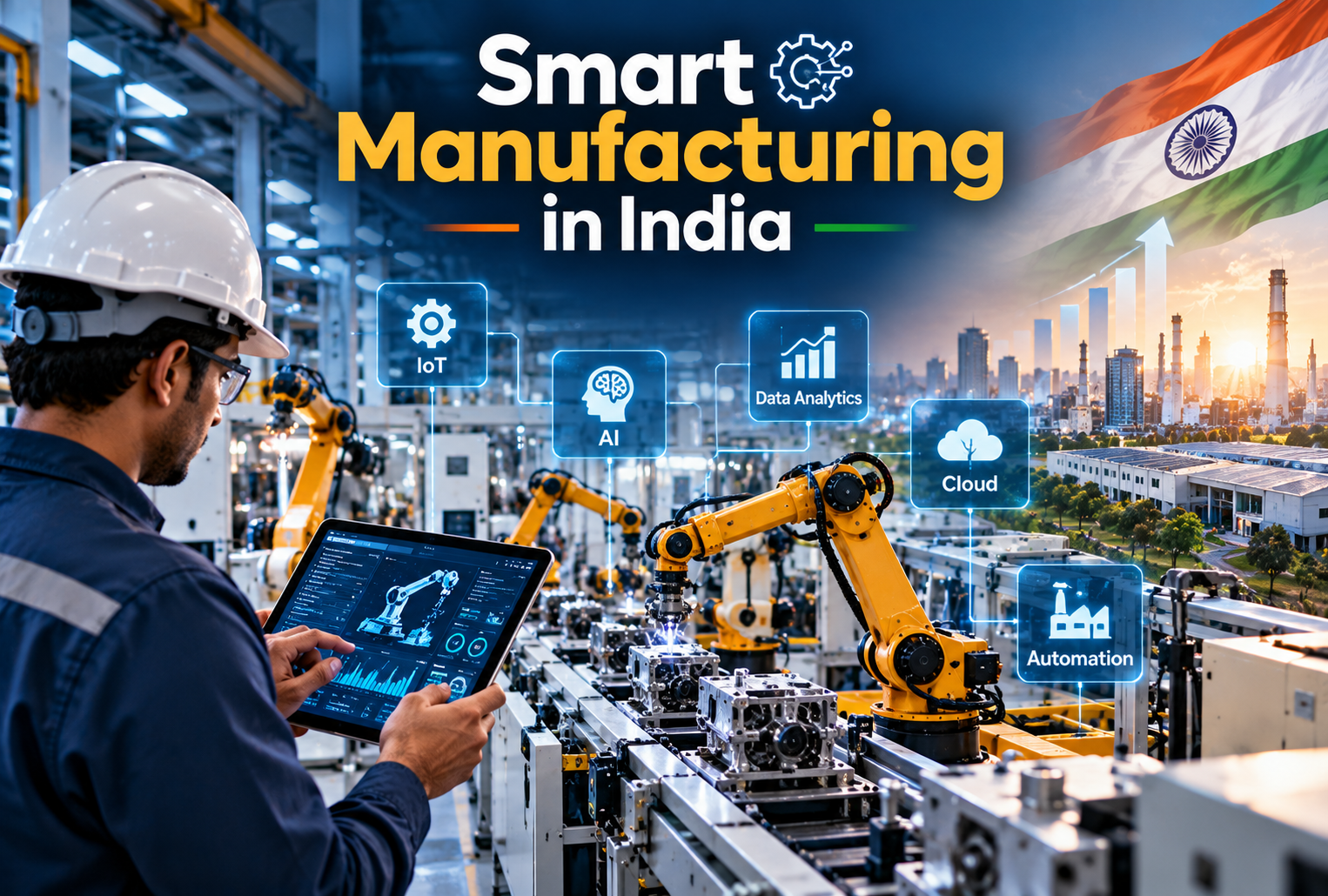
Introduction: The Rise of Smart Car Factories in India
India's automotive industry is evolving as manufacturers invest in automation, connected equipment, artificial intelligence and digital production systems. Traditional factories relied heavily on fixed production processes and manual inspections. Modern smart factories increasingly combine machines, sensors, software and real-time data to help teams make faster decisions.
This transformation is part of Industry 4.0, a term used to describe the integration of digital technologies into industrial operations. In automotive manufacturing, it can include robotic assembly, machine-vision inspection, predictive maintenance, connected supply chains and digital monitoring of production lines.
A recent Automotive Skills Development Council article on AI in automotive manufacturing explains how AI can help factories analyse patterns, identify problems and support better decisions on the production floor.
The goal is not simply to install more robots. Smart manufacturing aims to make production more reliable, efficient, flexible and responsive to changing demand.
What Is Smart Manufacturing?
Smart manufacturing uses connected machines, industrial software and data analysis to improve production processes. Sensors can collect information about temperature, vibration, speed, energy consumption and machine performance. That information can then be used to monitor operations and identify unusual conditions.
In a conventional factory, a problem may only become visible after a machine stops or a quality inspection identifies defective output. In a connected factory, monitoring systems may detect an abnormal pattern earlier, allowing engineers to investigate before the issue causes a larger disruption.
The level of automation varies between factories. Some use connected sensors and dashboards, while others integrate robots, machine vision, manufacturing execution systems and advanced analytics.
A factory does not need to automate every operation to benefit from smart manufacturing. Even a limited system that monitors critical equipment or tracks quality defects can improve visibility and help managers make better decisions.
How Connected Machines Work
Connected machines use sensors, industrial controllers and communication networks to share operational data with monitoring or production systems.
For example, equipment on a vehicle assembly line may report operating speed, cycle time and error codes. Software can combine these signals with production schedules and maintenance records to show whether the line is operating as expected.
A manufacturing execution system, or MES, can help track production activity, work orders, quality checks and material usage. When connected with other business systems, this information can help managers understand how factory operations relate to inventory, planning and delivery commitments.
However, connectivity alone does not guarantee better performance. Data must be accurate, systems must communicate reliably and employees must understand how to use the information.
Five Ways Smart Technology Is Transforming Car Factories
1. Robotics in Assembly and Material Handling
Robots are widely suited to repetitive or physically demanding tasks, such as welding, lifting, handling components and applying materials with consistent movements.
In car factories, robotic systems can help maintain repeatability across large production volumes. They can also reduce the need for workers to perform certain hazardous tasks directly.
Collaborative robots, or cobots, are designed for selected applications where people and automated equipment work in closer proximity under appropriate safety controls. Their suitability depends on the task, risk assessment and factory layout.
Robots do not eliminate the need for skilled workers. Factories still require technicians, engineers and operators to programme equipment, inspect output, maintain machines and respond to unexpected conditions.
2. AI-Powered Quality Inspection
Vehicle production requires consistent quality across components, paintwork, welds, assembly operations and finished vehicles. Machine-vision systems use cameras and image-processing software to inspect products for visible defects.
AI models may help identify patterns in images that are difficult to assess consistently through manual inspection alone. They can flag potential defects for further examination and help quality teams analyse recurring problems.
For example, an inspection system might detect an unusual surface mark or a component that appears incorrectly positioned. The result can then be reviewed according to the factory's quality procedures.
AI inspection is not infallible. Poor lighting, changes in materials, insufficient training data and unusual defect types can affect performance. Human review and regular validation remain important, especially for safety-critical components.
3. Predictive Maintenance
Unexpected machine failures can interrupt production, delay orders and increase maintenance costs. Predictive maintenance uses equipment data to identify signs that a machine may require attention.
Sensors may monitor vibration, temperature, pressure or other operating conditions. Analytics can then help maintenance teams investigate unusual patterns and prioritise inspections.
This approach differs from waiting for equipment to fail or replacing every component at a fixed interval. Maintenance can instead be planned around observed conditions and equipment requirements.
The benefits depend on data quality and implementation. A prediction system that produces too many false alarms may create extra work, while an unreliable system could miss an important warning. Manufacturers need suitable sensors, clear maintenance procedures and trained technicians.
4. Digital Twins and Real-Time Production Monitoring
A digital twin is a digital representation of a physical asset or process. Depending on the application, it may combine design information, sensor readings, production data and simulations.
Manufacturers can use digital models to study how changes in a process might affect production before implementing them on the actual factory floor.
For example, engineers may evaluate a revised assembly sequence or assess whether a production line can handle a different vehicle configuration. The usefulness of a digital twin depends on how closely the model reflects real operating conditions.
Real-time dashboards can also help managers track production output, machine availability, quality indicators and bottlenecks. These tools make it easier to identify where delays are occurring and decide which issue needs attention first.
5. Connected Supply Chains
Car manufacturing depends on thousands of parts and components supplied by different businesses. A delay in one critical component can affect an entire production schedule.
Connected supply-chain systems can improve visibility into inventory, supplier deliveries, material availability and order status. When these systems are integrated effectively, planners can identify shortages earlier and coordinate responses.
AI may help analyse historical demand, detect unusual patterns or support forecasting. Nevertheless, forecasts remain uncertain, especially when demand changes suddenly or suppliers face unexpected disruptions.
Reliable supply-chain planning still depends on accurate data, good supplier relationships and practical contingency plans.
Why Smart Manufacturing Matters for India
India's automotive industry serves a large domestic market and also participates in international supply chains. Manufacturers must balance production costs, quality expectations, product variety and delivery schedules.
Smart manufacturing can help Indian factories improve consistency and use resources more efficiently. It may also support the production of vehicles with different powertrains, including petrol, hybrid and electric models, where manufacturing processes and component requirements can differ.
The Confederation of Indian Industry's Automotive Industry 4.0 publication discusses the role of Industry 4.0 in strengthening India's automotive value chain and supporting modern production capabilities.
Smaller component suppliers are also important. If large manufacturers adopt digital processes while smaller suppliers remain disconnected, gaps in information can still cause delays. Making digital tools practical and affordable for suppliers is therefore an important part of the wider transformation.
Challenges in Adopting Smart Manufacturing
High Initial Investment
Sensors, robotics, software integration, network upgrades and employee training can require substantial investment. Businesses should identify the operational problem they want to solve before purchasing equipment.
Skills and Training
Workers need the ability to interpret dashboards, maintain connected equipment and respond to system alerts. Manufacturers may need to invest in technical training and closer cooperation between production, engineering and IT teams.
Cybersecurity
Connected machines expand the number of systems that need protection. Poorly secured industrial networks can expose production operations to cyber incidents.
Manufacturers should restrict access, segment networks, patch systems where appropriate, back up critical configurations and prepare incident-response plans. Operational technology should not be treated like ordinary office software because interruptions can affect physical production and worker safety.
Integration With Existing Equipment
Factories often operate machinery from different manufacturers and different generations. Connecting these systems can be difficult when communication standards, data formats or software capabilities differ.
A phased approach can help businesses prioritise high-value areas instead of attempting a complete factory transformation at once.
What Does the Future of Indian Car Factories Look Like?
The next stage of smart manufacturing is likely to involve deeper integration between AI, robotics, connected machines and production planning. More factories may use data to identify quality issues earlier, improve maintenance scheduling and adjust production to changing demand.
However, fully autonomous factories are not the only possible outcome. Many operations will continue to rely on people for complex decisions, supervision, quality assessment and maintenance.
The strongest results are likely to come from combining technology with reliable processes and skilled employees. A connected machine is valuable only when its data leads to a useful action.
Conclusion
Smart manufacturing is changing how Indian car factories approach production, quality control, maintenance and supply-chain coordination. Connected machines provide operational data, AI can help identify patterns, and robotics can improve repeatability in suitable tasks.
The transition also brings challenges, including investment costs, workforce training, data quality and cybersecurity. Manufacturers that adopt technology gradually, measure the results and maintain human oversight will be better positioned to gain practical value.
The future of automotive manufacturing in India will depend not just on how many machines are connected, but on how effectively factories turn information into safer, higher-quality and more reliable production.