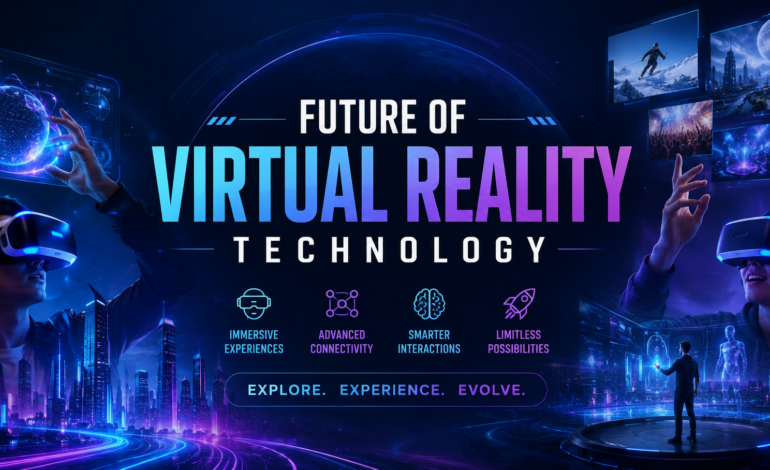
Future of Virtual Reality Technology: Trends that will Change the World

Virtual reality technology is expanding far beyond gaming. The global VR market was valued at $20.83 billion in 2025 and is projected to reach $26.71 billion by 2026, driven by advances in hardware, AI-powered content, and real-world applications in healthcare, education, and the workplace.
VR looks straightforward until you realize how fast it is changing. Most people still picture clunky headsets and motion sickness. That picture is outdated.
Over 171 million people used VR in 2024, and that number is climbing. The hardware is lighter. The content is smarter. And the industries adopting it — from surgical training to classroom learning — are not doing it for novelty. They are doing it because it works.
This post breaks down where VR technology stands right now, what is changing by 2026, and which industries are seeing the most meaningful impact. If you are tracking technology trends, this is one you cannot afford to misread.
What is driving the VR market’s rapid growth right now?
The VR market is not growing because of hype alone. Three converging factors are accelerating adoption in 2026:
- Hardware costs are dropping. Wireless, untethered headsets are becoming the standard. Devices are lighter, batteries last longer, and the resolution gap between consumer and enterprise headsets is narrowing.
- AI is making content adaptive. Static VR environments are being replaced by AI-driven simulations that respond to user behavior in real time, creating experiences that hold up under repeated use.
- Enterprise ROI is becoming measurable. Healthcare, defense, and education sectors are no longer running VR pilots — they are scaling deployments because the training outcomes justify the cost.
The global VR market was valued at $20.83 billion in 2025 and is projected to grow to $26.71 billion by 2026, according to Fortune Business Insights. That is not a speculative forecast. It reflects procurement decisions already being made.
How is VR technology changing in 2026?
What hardware advances should you expect from VR headsets in 2026?
Current headsets do a decent job. The next generation does better in ways that matter for extended use:
- Weight reduction. Most enterprise users hit discomfort after 20–30 minutes with current hardware. Lighter form factors are pushing that threshold significantly higher.
- Wider field of view. Narrow FOV breaks immersion during fast movement. New display architectures are addressing this without increasing power draw.
- Wireless + precision tracking. Tethered setups limit physical movement. Untethered systems with low-latency optical tracking now deliver the accuracy that tethered setups once monopolized.
- Mixed reality convergence. Devices that shift fluidly between full VR and augmented overlays are moving from prototype to product in 2026.
The engineering challenge is not building one of these features. It is building all of them affordably. That is still unsolved for the consumer market, which is why location-based VR venues are seeing stronger growth than home hardware sales.
How is AI changing VR software and content creation?
AI integration is where the biggest shift is happening. VR used to require expensive, hand-authored content. That bottleneck is opening up.
AI-driven environments adapt to how a user behaves, not just what they select. Non-player characters are moving past scripted dialogue trees toward context-aware responses. Training simulations can generate scenario variations automatically, which cuts content production costs significantly.
For gaming, this means adaptive storylines and dynamic world states. For medical training, it means realistic patient simulations without rebuilding each scenario manually. The underlying technology is the same — the application determines the value.
What are the biggest VR use cases transforming industries in 2026?
How is VR being used in healthcare training and patient care?
Healthcare is where VR’s value is clearest and most defensible. The VR in healthcare market reached $5.62 billion in 2025 and is projected to reach $7.58 billion by the end of 2026, according to Treeview Studio.
The core use cases are not experimental:
- Surgical simulation. Surgeons practice complex procedures in realistic VR environments before performing them on patients. Error rates during actual procedures drop when surgeons have VR repetition logged.
- Pain management. VR distraction therapy is being used in burn units and post-operative recovery to reduce reliance on opioid analgesics.
- Phobia and PTSD treatment. Controlled exposure therapy in VR allows clinicians to adjust intensity in real time, which physical environments cannot replicate.
- Patient education. Showing a patient their own anatomy in 3D before a procedure increases comprehension and reduces pre-operative anxiety.
The AR and VR healthcare market is projected to exceed $3.81 billion in 2026 and reach $27.98 billion by 2035, per Towards Healthcare. That trajectory is driven by hospital procurement, not consumer interest.
How is VR changing education and student learning outcomes?
VR in education sounds promising until you ask whether it actually improves learning — not just engagement. The research is building in favor of specific use cases.
The global VR in education market is projected to grow from $24.24 billion in 2026 to $83.09 billion by 2034, according to Fortune Business Insights. The compound annual growth rate over that period is substantial enough that most major education technology vendors are now building VR components into their platforms.
What works in educational VR:
- Historical and geographical immersion. Students exploring ancient Rome or the surface of Mars retain spatial and contextual information differently than students reading about it.
- Science lab simulations. Schools without lab budgets or equipment access can run full chemistry and biology experiments virtually without safety risks or material costs.
- Skills training at scale. Vocational programs in welding, electrical work, and construction are using VR to provide repetitions that physical labs cannot deliver at volume.
- Language and cultural immersion. Conversational VR environments accelerate language acquisition by simulating full-context social scenarios.
The caveat is content quality. Low-fidelity VR education tools exist in quantity. High-fidelity, curriculum-aligned tools are still limited, which is where the development investment is heading.
What is the future of VR in gaming and entertainment?
Gaming is where VR started and where hardware is most visible. The direction in 2026 is toward physical freedom and social play.
Free-roam VR — where players physically move through large, tracked spaces — is getting more sophisticated. The formula that works combines:
- Wireless, lightweight headsets
- Sub-20ms motion-to-photon latency
- Multi-user synchronization across shared virtual spaces
- High-fidelity content built on recognizable IP
Location-based VR venues are scaling this model. At-home VR gaming is still constrained by room size and hardware cost, which means the best experiences in 2026 are not going to happen in living rooms.
The content gap is also real. Most major game studios have not committed to AAA VR development because the current install base does not justify the budget. That math changes as headset adoption grows, but it has not changed yet.
How will VR reshape remote work and virtual collaboration?
Remote work created a known problem: video calls replicate presence badly. Virtual office environments built on VR are addressing the specific limitations that video cannot solve.
3D meeting spaces allow spatial audio, whiteboarding, and persistent virtual environments that participants return to. For teams doing design reviews, architecture walkthroughs, or technical training, the gap between a VR meeting and a physical one is narrowing.
The adoption blockers are familiar: hardware cost, setup friction, and the learning curve for non-technical users. Enterprises with distributed teams in high-value roles — defense, aerospace, product design — are absorbing those costs. The broader workforce is not there yet.
What is the difference between augmented reality and virtual reality in 2026?
AR and VR are converging, not competing. The practical distinction matters for use case selection:
- VR replaces the user’s environment entirely. Best suited for training, simulation, gaming, and any context where full immersion improves the outcome.
- AR overlays digital information onto the physical environment. Best suited for maintenance, navigation, surgical guidance, and contexts where real-world visibility is essential.
- Mixed reality (MR) sits between them, anchoring digital objects to physical surfaces. Adoption is accelerating in enterprise settings where workers need both hands free and both worlds visible.
Choosing AR over VR is not about preference. It comes down to whether the physical environment needs to remain visible during the task.
What challenges are slowing down VR adoption?
Three friction points keep showing up across industries:
- Motion sickness. A non-trivial percentage of users experience discomfort during extended VR sessions. The solution is not purely hardware — it also requires content designed with comfort in mind, including frame rate consistency and careful locomotion design.
- Content cost. Building high-quality VR experiences is expensive. Most VR content libraries are thin relative to what traditional software platforms offer. Until that changes, many potential users cannot find relevant applications.
- Enterprise integration. Deploying VR at scale inside organizations requires compatibility with existing IT infrastructure, device management systems, and compliance frameworks. That integration work is not trivial.
These are engineering and ecosystem problems. They are being solved, but not uniformly.
Where is VR technology headed beyond 2026?
The near-term trajectory is clear. Haptic feedback will move from vibration to full tactile simulation. Neural interfaces are in early development, with companies exploring direct sensory input. Social VR platforms will support persistent digital identities and economies.
The longer-term question is not whether VR will matter — the market data answers that. The question is which applications will justify the hardware investment and content development cost at each price point.
High-stakes training will continue to lead. Healthcare, defense, aviation, and industrial applications can calculate ROI precisely enough to fund VR programs regardless of consumer adoption curves. Consumer gaming will follow hardware cost reductions. Education will scale with curriculum integration.
Forbes noted in late 2025 that physical AI, spatial computing, and large language models are converging into what some analysts are calling VR+. That convergence is the next architectural shift — not just better VR, but VR that is contextually aware, AI-mediated, and physically integrated.
Your next move on VR technology
VR technology is not a single trend. It is a set of overlapping developments — hardware miniaturization, AI-driven content, enterprise deployment, and immersive social platforms — each moving at a different speed.
If you are evaluating VR for a specific application, start by identifying whether your use case requires full environment replacement or whether AR gets you the same outcome with less friction. If you are tracking VR as a technology trend, the healthcare and education market data is the clearest signal that this is already a production-scale deployment, not a future consideration.
The gap between what VR looks like in demos and what it does in real deployments is closing. That is what makes 2026 a meaningful inflection point.
For more information
- Future Technology Trends That Will Change The World
- Top 10 Technology Trends In 2026
- Best Upcoming Gadgets To Watch This Year
Frequently asked questions about virtual reality technology
What is the future scope of virtual reality technology?
The VR market is projected to grow from $20.83 billion in 2025 to over $26.71 billion by 2026. Long-term growth is driven by healthcare, education, enterprise training, and immersive entertainment. The technology’s scope expands as hardware costs drop and AI-generated content lowers production barriers.
How does virtual reality differ from augmented reality in practical use?
VR replaces your environment entirely and works best for simulation, training, and gaming. AR overlays digital content onto your physical surroundings, making it better for tasks where you need to see the real world — like surgical guidance or equipment maintenance. Mixed reality blends both.
Is VR in healthcare already being used, or is it still experimental?
VR in healthcare is in active production use. The market reached $5.62 billion in 2025 and is projected to reach $7.58 billion by end of 2026. Applications include surgical simulation, phobia treatment, pain management, and patient education — all with documented clinical outcomes.
What is holding back wider consumer VR adoption?
Three main factors: motion sickness in extended sessions, hardware cost for home setups, and limited high-quality content libraries. Location-based VR venues scale past the hardware problem by spreading device costs across many users, which is why that segment is growing faster than home consumer hardware.
How is VR being used in education right now?
VR in education is used for lab simulations, historical immersion, vocational skills training, and language learning. The market is projected to grow from $24.24 billion in 2026 to $83.09 billion by 2034. The gap between available VR hardware and curriculum-aligned content is the main adoption constraint.
What role does AI play in the future of virtual reality?
AI enables adaptive environments that respond to user behavior, realistic non-player characters, and automated content generation for training scenarios. This reduces the cost of building VR experiences and improves replayability — both critical factors for enterprise and educational deployments.